設定
設定
 迅速な配送
迅速な配送
 送料は無料
送料は無料
 Incoterms
 お支払い方法


 マーケットプレイス製品


Why Would I Use a Servomotor?
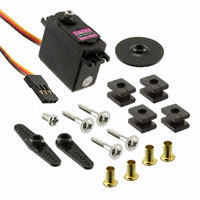 Adafruit's High-Torque Servo Motor
That’s an interesting question. We could look at the history of servomotors, but that is a long look at the invention of electric motors in the time of Tesla and Edison. We could look at the inventor of servomotors, but that is not exactly clear (though I prefer the idea that the first servomotor was created by James Servo). We could look at what someone thinks about when they first hear “servomotor.” Most people who hear “servo” most likely think about the little servo motors found in hobbyist kits and used in toy airplanes and such. Then again, if you work in the automation world, you probably think of the $10,000 motor you had to buy for the robot arms.
But what really is a servomotor? Servomotors can be defined as simply as a rotary actuator or linear actuator, read as motors, with built-in control circuitry. Now that is a very simple but vague definition. The problem is the level of control is very different between an industrial servomotor and a little DC servomotor. You also have to be careful not to include stepper motors in your definition. Steppers differ in how they are controlled. A servo keeps a measurement of its angle while a stepper motor moves in steps. This means that a servo will be told to move a certain angle while a stepper will be told to take 13 steps. The servo is in a closed loop control and has feedback of its position; the stepper is open loop and has measured steps, but has no feedback.
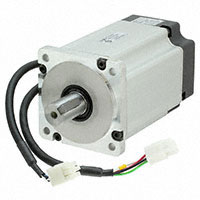 Panasonic Industrial Automation Sales' 3000 RPM Servo Motor
Simple DC servomotors are similar in idea of industrial servomotors, but also very different. One thing you will notice with a simple servo is it usually has three wires. An industrial motor has many more that usually connect into a special controller. The simple servo has a power, ground, and control pin. The control pin is usually just a PWM signal. The change in the width or timing of the pulse tells the servo what to do. For servos that only turn to a certain degree, it is usually along the lines of a 1 ms pulse for the 0 degree position, a 1.5 ms pulse for 90 degrees, and a 2 ms pulse for 180 degrees. For a continuous servo, which can turn 360 degrees, the pulse usually controls the rpm and directions. A 1.5 ms pulse is stop; anything greater than that would dictate clockwise motion and less than that would dictate counterclockwise motion. This makes servomotors the easiest motor to get started working with. All you need is PWM signal. Most microcontrollers have a timer built in that has a very easy way to make a PWM signal. To see more on creating that, you can visit our eewiki Driving Servomotors page, or if you want to learn a little more on the inner workings of servomotors and running it on an Arduino, check out this servo motor article on our website.
References:
1 – Gieras, Jacek F. Permanent Magnet Motor Technology: Design and Applications, Third Edition, pg. 26, Sept 20, 2017
2 – FASTECH, Why the Closed Loop Stepping System Has Better Performance Than The Servo Systems, Sept 20, 2017
著者について

DigiKeyのアソシエイトアプリケーションエンジニアであるBen Roloff氏は、2016年以来、すべてのマイクロコントローラのニーズを満たすためにお客様を支援してきました。彼はインターネットが家の中では前代未聞だった1991年に生まれました。学年が進むにつれて、インターネットはゆっくりと広がっていきました - ある意味で、Benはインターネットと共に成長してきました。コンピュータ工学の教育を追求するように駆り立てたのは、彼のコンピュータへの興味からです。彼はサウスダコタ鉱山技術大学でコンピュータ工学の科学学士号を取得しています。

Have questions or comments? Continue the conversation on TechForum, Digi-Key's online community and technical resource.
Visit TechForum