設定
設定
 迅速な配送
迅速な配送
 送料は無料
送料は無料
 Incoterms
 お支払い方法


 マーケットプレイス製品

メーカー品番 ABX00062
ARDUINO UNO MINI LE
Arduino

Everyone who’s tinkered with electronics has probably used an Arduino Uno at some point. It’s one of the most popular microcontroller boards in the world as it is reliable, simple, and a great platform for learning how hardware and software come together.
To celebrate the legacy of this amazing board, Arduino released the Arduino Uno Mini Limited Edition (LE), which is a smaller and slightly more powerful version that keeps all the power of the original in a new gold-and-black design. Let’s take a deep dive into what makes it special and how it compares to its older brother.
 Image Credit: https://commons.wikimedia.org/wiki/File:UNO-mini-LE-Packaging-sml-1024x683.png
The Uno Mini LE is a scaled-down version of the original Uno, which was made to mark over a decade of Arduino innovation. Even though it’s about half the size, it has many of the components and performance results as the Uno.
Just like the full-sized board, it uses the ATmega328P as the main microcontroller and the ATmega16U2 as the USB-to-serial converter. That means everything works exactly the same way as the Uno. It is basically the Uno, but smaller and with some very slight upgrades.
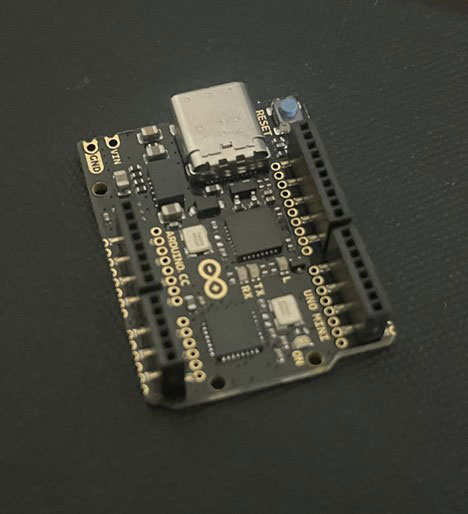
Underneath the gold accents, the Uno Mini LE is a fully functional development board. It has all you need to make your projects just like with the Uno. Even with the small size, it has the same GPIO pins as the Uno R3.
One of the biggest improvements is the jump from the old USB-B connector to a USB-C port. This modernizes the board and makes it a lot easier for people to actually interface with. Most people don't have a USB-B cable, but now we all have USB-C cables to charge our phones, which makes it more convenient to use.
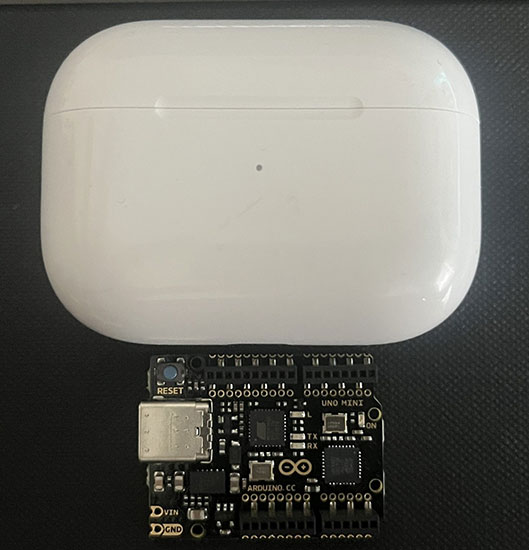
Functionally, both boards are identical. They share the same microcontroller, the same pin layout, and the same I/O voltage levels. If your code runs on the Uno, it will run on the Uno Mini LE without any changes.
Here’s what’s the same:
And here’s what’s new:
Despite its smaller footprint, the Uno Mini LE manages to keep the same pin headers (just in a denser layout), making it compatible with jumper wires and breadboards. This makes it perfect for prototyping and easier to fit into a housing due to its size.
 Image credit: https://en.wikipedia.org/wiki/Arduino_Uno
Power delivery on the Uno Mini LE is handled by an MPM3610AGQV step-down converter, capable of supplying up to 1.2A. This allows the board to maintain stable operation even when powering multiple peripherals. This could mean in many circumstances you won't need an external power supply going directly into the peripherals and can use on-board power. The board can be powered through USB-C up to 5.5V or through the VIN pin, which accepts up to 20V.
 MPM3610AGQV step-down converter
Image Credit: https://www.digikey.com/en/products/detail/monolithic-power-systems-inc/MPM3610AGQV-P/5299006
________________________________________
This little Arduino has just as many use cases as the original, if not more:
It’s designed as both a functional tool and a commemorative piece that celebrates what Arduino has done over the years. It can be used in many use cases, just like the Uno R3, but with the added benefit of being smaller with some upgrades.

Image Credit: https://commons.wikimedia.org/wiki/File:RoboRobo_Educational_Robots_2023.jpg
________________________________________The Arduino Uno Mini Limited Edition is a really great small protoboard for all your needs. It has everything that made the original Uno a great board, but with a smaller form factor. This smaller factor makes it a direct upgrade from the original and a worthy commemoration piece.
Whether you’re learning embedded programming, prototyping new hardware, or simply adding it to your collection, the Uno Mini LE is one of the best ways to do it.