Settings
 Fast Delivery
 Free Shipping
 Incoterms
 Payment Types


 Marketplace Product

Mfr Part # 113991114
XIAO ESP32S3
Seeed Technology Co., Ltd

License: General Public License GPS Arduino
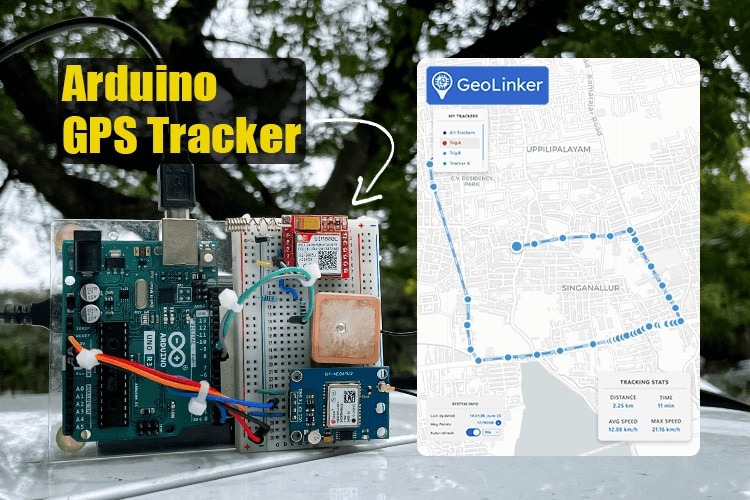
In the expanding world of IoT and embedded systems, GPS tracking remains one of the most practical and widely applied use cases — from monitoring vehicles and assets to ensuring safety and automation. This project demonstrates how to build an affordable, efficient GPS tracker using the compact Seeed Studio XIAO ESP32-S3 microcontroller and a Neo-6M GPS module, enhanced with geofencing and SMS alert capabilities — all without the need for a SIM card or cellular modem.
Traditional GPS trackers often depend on cellular service plans and GSM modules to transmit data — adding recurring costs and complexity. This design replaces the need for mobile networks with Wi-Fi connectivity and cloud services, making it an accessible project for students, makers, and professional engineers alike. By leveraging cloud APIs and geofencing logic, it delivers real-time tracking, automated alerts, and offline robustness, making it ideal for IoT and embedded applications.
The GPS tracker integrates several valuable features:
No Cellular Requirement: Uses Wi-Fi to send GPS updates to a cloud service, eliminating recurring SIM costs.
Geofencing Alerts: Automatically detects if the device exits a predefined zone and triggers responses.
SMS Notifications: Sends SMS notifications via a cloud API when geofence boundaries are breached.
Offline Data Buffers: Temporarily stores location data when Wi-Fi is unavailable and uploads later.
Real-Time Mapping: Visualize live location paths and history on cloud dashboards.
Low Cost & Compact: Small footprint thanks to the XIAO ESP32-S3 board and basic GPS module.
GPS Signal Acquisition: The Neo-6M module locks onto satellite signals to determine latitude and longitude.
Data Parsing: The XIAO ESP32-S3 reads GPS NMEA data over UART and interprets coordinates.
Cloud Upload: Coordinates are sent over Wi-Fi to a GPS tracking platform at regular intervals (configurable).
Mapping & Storage: The cloud service stores and displays the data on interactive maps.
Geofence Logic: The firmware calculates distance from a set “home” coordinate using geospatial formulas.
SMS Triggers: If the tracker moves beyond the geofence radius, an SMS alert is sent via the cloud API.
Seeed Studio XIAO ESP32-S3 – Compact Wi-Fi/Bluetooth microcontroller.
Neo-6M GPS Module – Provides satellite-based positioning data.
GPS Antenna – For reliable GPS reception.
Breadboard + Jumper Wires – For prototyping.
Arduino IDE – Development environment.
Libraries: GeoLinker, TinyGPSPlus, WiFiClientSecure.
The GPS module interfaces with the XIAO ESP32-S3 through UART communication. The GPS TX pin connects to the microcontroller’s RX pin, and vice versa for optional communication. Power and grounding are shared between modules. An external GPS antenna ensures good satellite reception.
Register on the Cloud Platform: Create an account to access the GPS tracking API.
Generate API Key: Required to authenticate uploads and enable SMS capabilities.
Configure Device Credentials: Add Wi-Fi SSID, password, API keys, and geofence radius into the firmware.
The firmware continuously:
Reads GPS coordinates.
Uploads them at set intervals.
Buffers data when offline.
Computes geofence distance.
Sends SMS alerts on geofence breach.
This modular and robust logic makes the system dependable even with intermittent connectivity.
This tracker is suited to:
Vehicle tracking and fleet management
Pet monitoring and safety
Asset protection
Outdoor equipment tracking
Personal safety geofencing
Its small form factor and Wi-Fi-based operation make it ideal for prototyping and real-world deployment.
This GPS Tracker with Seeed Studio XIAO ESP32-S3 project showcases how modern embedded platforms and cloud APIs can simplify complex IoT problems. By eliminating cellular dependencies and introducing geofencing with automated alerts, it provides a versatile solution for makers and professionals. Through Digi-Key’s ecosystem of components and tools, builders can expand this foundation into scalable IoT systems.