Settings
 Fast Delivery
 Free Shipping
 Incoterms
 Payment Types


 Marketplace Product


Robust SSRs for Demanding Food-Service Applications
Professional food service equipment must perform flawlessly in challenging environments, where factors such as high heat, steam, grease, vibration, and continuous operation must be taken into consideration. Sensors and reliable power-shifting components can ensure food safety and consistent cooking, providing designers with opportunities to create applications for an industry hungry for innovation. Replacing or updating aging control technology with more accurate sensors and reliable solid-state power control can provide a significant boost in improving food quality, energy efficiency, and health safety.
Building durable, high-performance machines increasingly means combining advanced sensing technology with solid-state relays (SSRs) that deliver precise, repeatable power control. Sensata-Crydom, a brand of Sensata Technologies, offers a food-service-ready, DIN-rail mounted SSR that delivers industrial-grade switching, packaged for compact control panels.
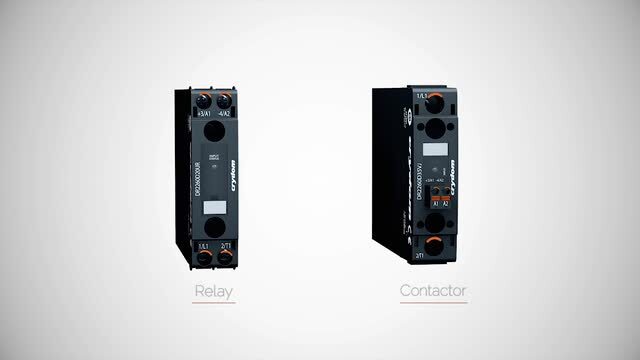
With models rated at 27 A and 32 A, and operating voltages up to 600 VAC, the DR22C Series (Figure 1) can handle the high-power heaters and motors common in commercial ovens, fryers, ice makers, and coffee machines, as well as fans and pumps. This capability provides engineers with flexibility and simplicity in creating variants to exploit different opportunities in the food service market.
 Figure 1: DR22C Series assemblies incorporate an SSR module within a compact DIN-rail carrier assembly. (Image source: Sensata-Crydom)
The market for automation in the food service industry is expanding at a compound annual growth rate of 10%, from more than $15 billion in 2024 to more than $24.11 billion in 2029.[1] Automation, smart sensors, and IoT are among the key trends driving that growth, and high-performance components like SSRs designed for harsh environments can give designers a competitive edge.
Components in food service systems must withstand frequent cleaning, high humidity, and wide temperature variations. High-performance components also ensure operational consistency and reduced downtime, which is critical in food production where process interruptions can lead to product spoilage and safety issues.
Applications that meet global standards for electrical safety, electromagnetic compatibility, industrial durability, and cleaning requirements are essential to commercial success. Designing with certified components like the DR22C Series helps manufacturers shorten compliance cycles and scale products across multiple regions with fewer redesigns.
DR22C Series SSRs eliminate mechanical contact wear, improving uptime in high-duty-cycle environments where failures mean disrupted service and costly maintenance. Features such as 4000 Vrms isolation protect sensitive control logic from mains power in metal, splash-prone enclosures. High-surge-current tolerance handles the demanding inrush loads of heating elements and motors during startup, a common failure point for electromechanical relays.
Integration and compliance focus
The DR22C Series is designed with integration and compliance in mind. DIN-rail mounting and generous thermal margins simplify enclosure layout and reduce the need for custom hardware or frequent derating. Their -40°C to 80°C operating temperature range provides stability even when equipment panels heat up under continuous operation or during aggressive cleaning cycles.
With an optimized thermal path from the power devices to the relay’s metal baseplate, designers can take advantage of efficient heat transfer into a DIN-rail heat sink or the equipment chassis. The relays are housed in a 22.5 mm-wide industrial package with a low-depth integral heat sink, making them ideal for control panels where space, particularly depth, is limited. The heat sink can simplify thermal management, while a Direct Bonded Copper (DBC) substrate ensures superior heat spreading and reliable operation under continuous load.
The ability to deliver robust performance in a space-efficient package can lead to reduced cabinet size without compromising high reliability. An IP20 touch-safe housing adds to operator safety during and after installation. The zinc-plated steel DIN-rail clip enables the DIN rail to serve as a grounding bus bar when used with a ground terminal block; this can eliminate the necessity of a separate PE connection.
The DR22C Series SSRs are a compact, ready-to-use solution for switching small and medium AC loads. A removable input connector with spring cage terminals allows for speedy, simple installation. Built-in LED indicators simplify troubleshooting and can aid predictive maintenance by signaling abnormal operation.
The DR22C Series also supports a wide range of control voltages, making it easy to integrate into both traditional analog systems—like simple thermostat or timer loops—and modern digital or connected architectures that include sensors, PLCs, or IoT diagnostics. This flexibility lets designers standardize on a single relay for multiple applications, whether the equipment is purely mechanical, partially automated, or fully networked.
As a family of 48 to 600 VAC output SSRs, the DR22C Series is available in two current ratings (27 A and 32 A) and offers control‑voltage options. Among those variants are:
- The DR22C60A27VJ, which is rated for a 27 A load current and accepts a 90 to 280 VAC/VDC control voltage, is suitable for standard AC or mixed‑voltage control logic.
- The higher capacity DR22C60D32VJ is rated for a 32 A load and uses a 4 to 32 VDC control voltage. It’s tailored for more demanding loads and modern control systems, such as low‑voltage DC, PLCs, and IoT.
Other variants in the DR22C Series offer combinations of zero‑cross or instantaneous turn‑on switching and different control-voltage ranges, giving designers flexibility to match the relay to specific load types, control architectures, and thermal requirements.
Conclusion
Sensata-Crydom's DR22C Series SSRs are certified to multiple international standards and can help accelerate regulatory approval. Since all utilize the same DIN‑rail footprint, designers can take advantage of scalability with one mechanical package while covering both moderate and high-power loads. This provides a straightforward path to building smarter, safer, and more reliable professional food equipment.
[1] "Food Automation Global Market Report 2025," January 2025. The Business Research Company.
About this author

Pete Bartolik is a freelance writer who has researched and written about IT and OT issues and products for more than two decades. He previously was news editor of the IT management publication Computerworld, editor-in-chief of a monthly end-user computer magazine, and a reporter with a daily newspaper.

Have questions or comments? Continue the conversation on TechForum, DigiKey's online community and technical resource.
Visit TechForumMore Blogs from this Author